

From Farm Data to Better Liming Decisions
WA Farm Data Sharing Project
October 2, 2026
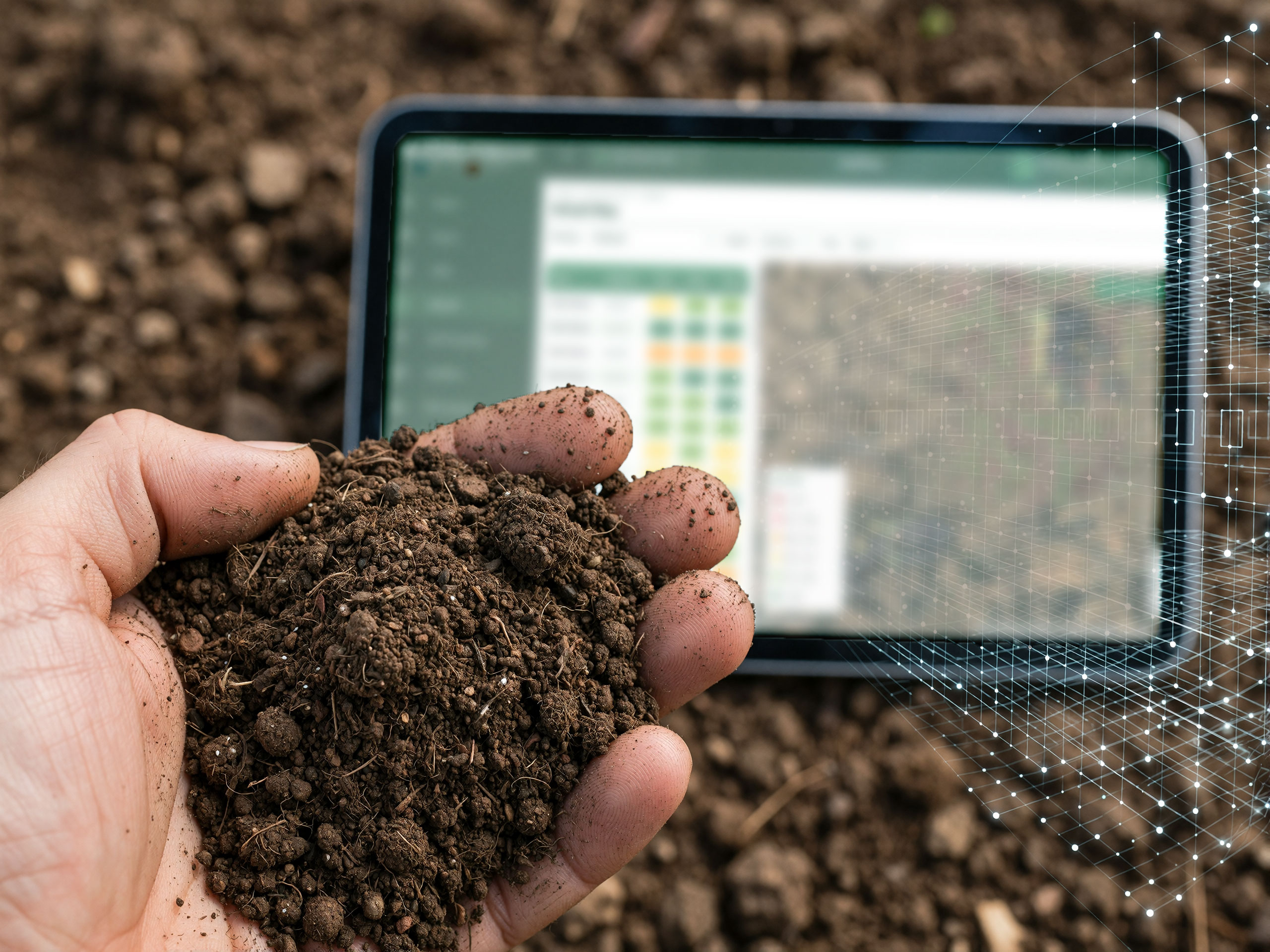
Western Australian grain growers collect valuable information through soil testing, machinery, farm management platforms, spreadsheets and paddock records. However, this data is often held across separate systems and in different formats, making it difficult to bring together when making significant farm investment decisions.
In parallel, research organisations have developed decision-support calculators tools that while they contain complex methodology often require manual data entry and generate single, whole farm level outputs.
The WA Farm Data Sharing Project funded by Food Agility CRC explored how growers could securely reuse their existing farm data, share it with a relevant research organisation and in return receive useful, farm-specific decision support.
Lime decision support was selected as the first use case because soil acidity is a significant and costly constraint for Western Australian grain businesses, lots of soil testing results were available and WA’s Department of Primary Industries & Regional Development (DPIRD has an advanced, but single use, liming calculator in iLime.
Project Partners
The project was led by DPIRD and delivered in partnership with Food Agility CRC, Grower Group Alliance (GGA), Curtin University and AxisTech.
Together, the partners combined agricultural research, grower knowledge, data systems integration, secure data exchange, advanced data modelling and grower-oriented user interface delivery.
The Challenge
Liming decisions are rarely straightforward.
Growers need to consider soil pH, paddock variability, crop rotations, seasonal conditions, lime quality, freight, application costs and long-term financial risk and both short-term and long-term yield benefits in calculating a liming strategy. They also need to assess which paddocks require attention, prioritise paddock applications, determine how much lime to apply, which sources of lime to use, whether incorporation is justified and when lime may need to be reapplied in the future.
The information needed to make these decisions may be spread across soil test reports, farm management systems, paddock records, spreadsheets, paper files and pulled together by the farmer and their technical experts (agronomists/consultants).
Grower research conducted through the project found that existing tools generally provided only part of the information required. Growers were combining soil tests, maps, agronomic advice, calculators and their own knowledge to determine lime rates, timing and priority paddocks.
The project set out to demonstrate how these fragmented data sources could be securely brought together and used to support a whole-farm liming decisions.
From Modelling to Grower Decision Support
AxisTech provided the systems integration and data management capability required to translate the project’s complex modelling outputs into information growers could access, understand and use.
Our role included digitising and structuring farm data, onboarding growers through AxisStream, developing the dashboard and visualisation environment and supporting the movement of data and model outputs through the project workflow.
The completed workflow brought together:
Grower data in AxisStream → secure exchange through Extrata → modelling through LEAP and iLime → results returned to growers through a Liming Scenario Planning Tool.
This created a complete data-to-decision pathway rather than leaving the project outputs as a standalone model or large technical report.
For AxisTech, this is where the project became particularly interesting. It provided an opportunity to do what we do across many complex, collaborative industry projects: bring together data, research and technology; turning this informationinto something growers can genuinely use.
Developing the Liming Scenario Tool
At the centre of the project was the Lime Enterprise Analysis Pipeline, known as LEAP.
LEAP extended DPIRD’s existing iLime and Optlime modelling from a largely manual, single-paddock process into a whole-farm optimisation framework.
The framework can process multiple paddocks, soil sampling locations, crop rotations, yield, rainfalland price assumptions and liming strategies over a 20-year period.
Monte Carlo simulations are used to generate a broad range of possible outcomes rather than one fixed prediction, with associated likelihoods.
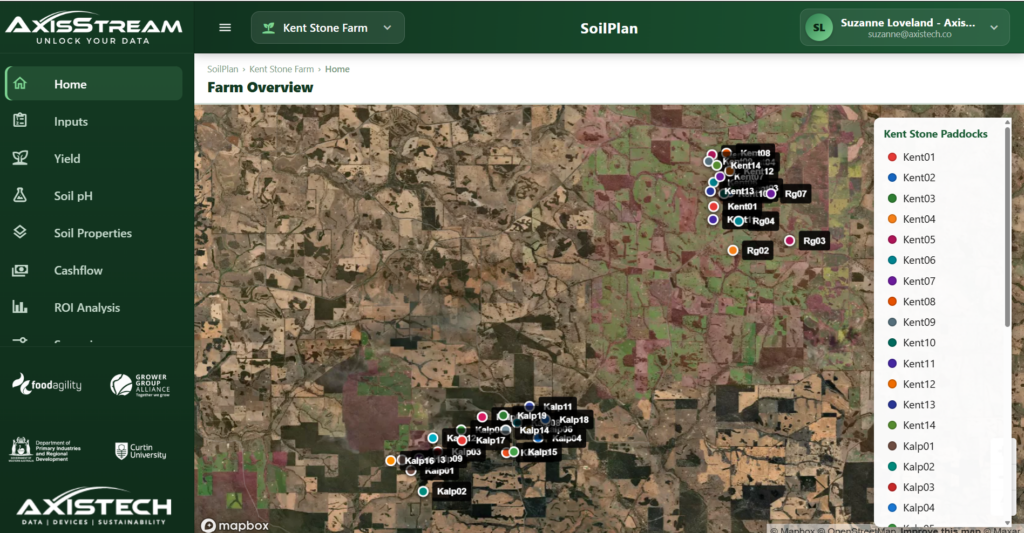
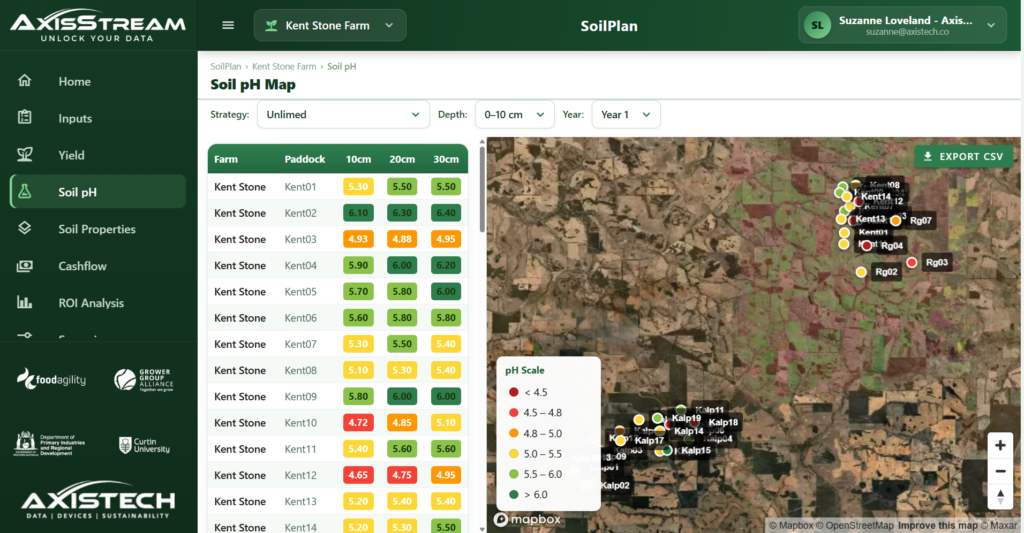
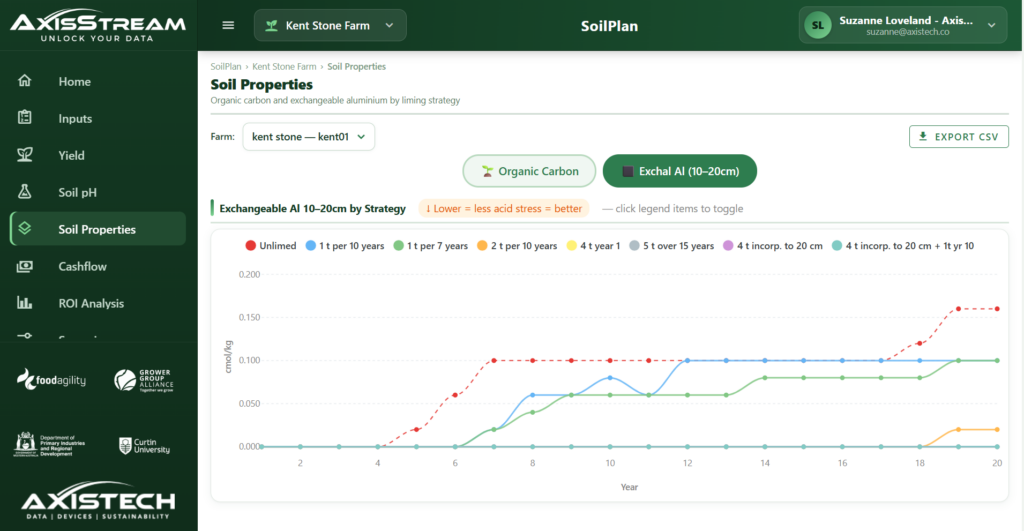
AxisTech developed a dashboard which was the the grower-facing assessment environment that transformed these modelling outputs into maps, graphs, tables and scenario comparisons for growers to be able to filter key decision points like pH levels across farms, crop rotations or budget and identify optimal production and financial returns.
Depending on the available farm data, growers can use the tool to:
- review soil pH at different depths
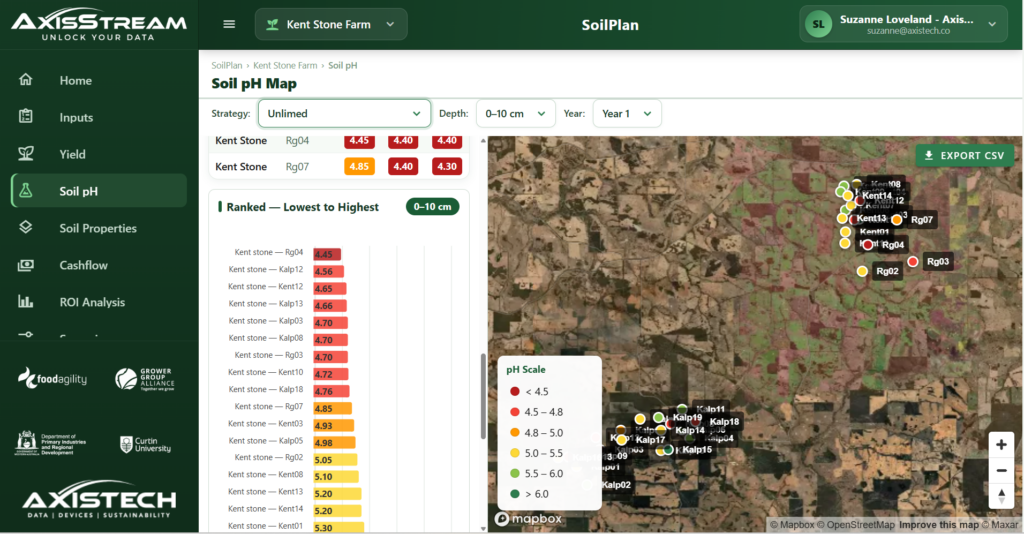
- identify paddocks requiring attention
- compare lime rates and application strategies
- view projected changes in soil pH and exchangeable aluminium
- compare indicative agronomic and financial outcomes
- understand when future lime applications may be required
- export results for further analysis.
Designed with Growers
Grower feedback played an important role in shaping the tool.
AxisTech worked with Grower Group Alliance to conduct platform demonstrations and individual review sessions with growers and advisers. Participants were able to view the platform using their own farm data where available and provide direct feedback on the layout, data, assumptions and usability.
Growers responded positively to the whole-farm map, pH colour coding, paddock navigation and the ranked list of paddocks requiring attention. They also valued the ability to compare different strategies over 20 years and view soil and cashflow outcomes in a clear format.
Feedback also helped identify improvements and this process reinforced that growers want tools that support their knowledge and decision-making rather than replace it.
The Outcome
The project resulted in a Liming Scenario Tool now known as SoilPlan that brings together farm data, soil information and science-backed modelling in a clear, grower-facing environment.
SoilPlan allows growers and advisers to compare alternative liming strategies and consider the trade-offs between soil improvement, cost, timing and long-term financial outcomes.
The project also demonstrated that grower data can be securely collected from multiple sources, structured for reuse, transferred securely and processed through advanced modelling and returned through systems that growers can understand and use.
For AxisTech, this project reinforced the importance of combining strong digital foundations with grower engagement and agricultural research. Complex modelling creates real value when its outputs can be translated into clear information that supports a real decision on farm.
The architecture developed through the project also has potential beyond liming. The same workflow could support other researcher-developed models and algorithms, using farm data to turn complex research outputs into practical, grower-facing decision support. Depending on the use case, this could support decisions at a whole-farm, field or sub-field level across areas such as broader soil amelioration, nutrient management, crop rotations, machinery investment and other areas where growers need to compare options, costs and risks. Within soil amelioration, for example, this could extend to decisions around deep ripping, clay spreading, deep placement and spading, alongside lime.
We are proud of what the project partners have achieved together and excited to see SoilPlan move into its next stage.
AxisTech is currently establishing easy-to-use workflows for growers and is looking for additional growers to test the tool and provide further feedback as we continue to develop SoilPlan within the AxisStream platform.
The WA Farm Data Sharing Project did more than demonstrate that farm data could be shared securely. It showed how that data could be transformed into a tool designed to support better decisions on farm. We are looking forward to seeing where this collaborative approach to farm data, modelling and grower-facing decision support can take us next.
For more information about the WA Farm Data Sharing Project or SoilPlan, contact AxisTech at info@axistech.co.